Have you ever stopped to think about how many times a day you interact with a machine that “thinks”? If you are like most people in the modern world, the answer is probably: constantly. From the moment your smartphone alarm wakes you up at the optimal point in your sleep cycle, to the personalized movie recommendations you scroll through before bed, Artificial Intelligence (AI) has quietly become the invisible engine powering our daily lives.
For decades, the concept of AI was confined to the realm of science fiction. We imagined metallic humanoids taking over cities or supercomputers going rogue. However, the reality of artificial intelligence is far more practical, incredibly fascinating, and deeply integrated into the fabric of our society. It is no longer a futuristic concept waiting on the horizon; it is here, it is learning, and it is transforming everything we know about how the world operates.
In this comprehensive guide, we are going to peel back the curtain on artificial intelligence. We will explore what it actually is, how it is disrupting major industries, the explosive rise of generative AI, and the ethical questions we must answer as we step into this brave new world.
Moving Beyond the Hype: What is AI, Really?
To understand the impact of AI, we first need to strip away the Hollywood dramatization and look at the technology itself. At its core, Artificial Intelligence is a branch of computer science dedicated to creating systems capable of performing tasks that typically require human intelligence. This includes visual perception, speech recognition, decision-making, and translating between languages.
But how does a machine actually “learn”? The secret lies in a subfield called Machine Learning (ML). Traditional computer programs are built on rigid, rule-based coding: If X happens, then do Y. Machine learning, on the other hand, flips this script. Instead of being explicitly programmed to perform a task, the system is fed massive amounts of data and trained to recognize patterns.
Think of it like teaching a child to recognize a cat. You do not give the child a mathematical formula for a cat’s dimensions; you show them dozens of pictures of cats until their brain makes the connection. Machine learning algorithms do exactly this, but at a scale and speed that is unfathomable to the human brain.
“Artificial Intelligence is the new electricity. Just as electricity transformed almost everything 100 years ago, today I actually have a hard time thinking of an industry that I do not think AI will transform in the next several years.” — Andrew Ng
How AI Quietly Runs Your Daily Life
You do not need a degree in computer science to benefit from AI; you are likely using it right now. Tech giants and app developers have seamlessly integrated complex algorithms into intuitive consumer products. Here are just a few ways AI works behind the scenes in your day-to-day routine:
-
Social Media Feeds: Platforms like Instagram, TikTok, and X (formerly Twitter) use highly sophisticated AI to analyze your viewing habits. They track how long you linger on a post, what you “like,” and what you share, instantly curating a feed designed specifically to keep you engaged.
-
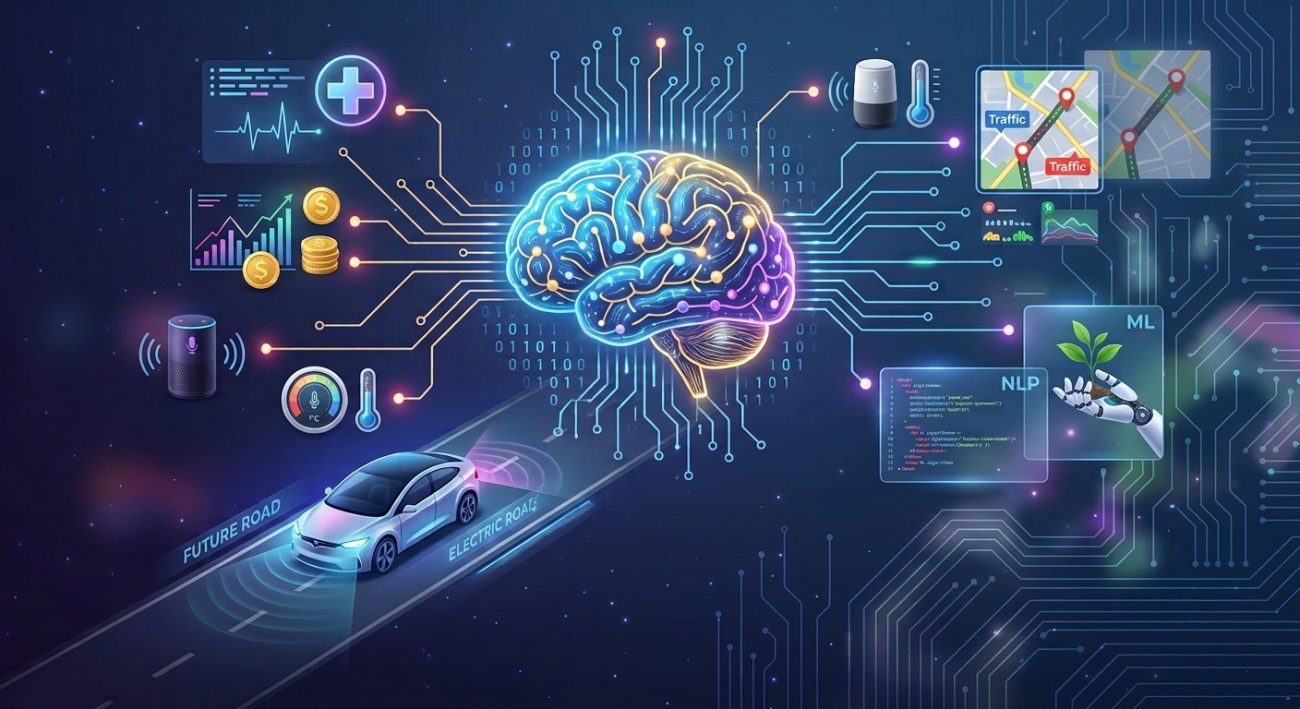
Navigation Apps: Google Maps and Waze do not just read static maps. They use AI to analyze real-time data from millions of other smartphones on the road, factoring in traffic jams, road closures, and even weather conditions to calculate the fastest possible route for your commute.
-
Smart Home Devices: Voice assistants like Alexa, Siri, and Google Assistant rely on Natural Language Processing (NLP). This allows them to parse human speech, understand context, and execute commands—whether you are asking for the weather forecast or telling your smart thermostat to cool down the living room.
-
Banking and Fraud Detection: Have you ever received a text from your bank asking if you just made a suspicious purchase halfway across the world? That is an AI algorithm continuously monitoring your transaction history, flagging anomalies that deviate from your normal spending patterns in milliseconds.
Revolutionizing Global Industries
While consumer conveniences are fantastic, the true power of artificial intelligence lies in its ability to solve massive, complex problems across critical sectors. We are seeing paradigm shifts in industries that have operated the same way for decades.
Healthcare: A Matter of Life and Death
Nowhere is the impact of AI more profound than in the medical field. Doctors and researchers are utilizing deep learning models to analyze medical imagery—such as X-rays, MRIs, and CT scans—with a level of accuracy that often surpasses human radiologists. AI can detect the earliest microscopic signs of tumors, predicting cancer long before a human eye could spot the abnormality. Furthermore, AI is accelerating drug discovery, simulating millions of chemical combinations in weeks instead of years, which is bringing life-saving medications to the market faster than ever before.
Finance: Speed, Accuracy, and Efficiency
The financial sector thrives on data, making it a perfect playground for AI. Quantitative hedge funds use algorithmic trading systems that can execute thousands of trades per second based on predictive models analyzing global market sentiment, news headlines, and economic indicators. Beyond high-frequency trading, AI is democratizing finance by powering robo-advisors that manage personal investment portfolios for everyday people, automatically adjusting asset allocations based on risk tolerance and market shifts.
Transportation and Logistics: The Road to Autonomy
Self-driving cars are no longer just a prototype. Companies like Tesla and Waymo are pushing the boundaries of autonomous navigation, using arrays of cameras, radar, and lidar sensors paired with AI to interpret road conditions and make split-second driving decisions. Behind the scenes, global supply chains are being optimized by AI to predict inventory shortages, route cargo ships more efficiently, and manage warehouse logistics using automated robotics.
The Generative AI Boom
If there is one aspect of AI that has completely captivated the public imagination recently, it is Generative AI. For a long time, machines were seen as analytical and logical, while creativity was considered a uniquely human trait. Generative AI has shattered that barrier.
Tools like ChatGPT, Claude, and Midjourney are powered by Large Language Models (LLMs) and advanced neural networks that do not just analyze data—they create entirely new content.
| AI Tool Category | What It Does | Popular Examples |
| Text Generation | Writes essays, code, emails, and stories. | ChatGPT, Claude, Jasper |
| Image Creation | Generates photorealistic images and art from text prompts. | Midjourney, DALL-E 3, Stable Diffusion |
| Audio/Video | Clones voices, creates music, and generates video clips. | Runway, Suno, ElevenLabs |
This generative wave is fundamentally altering how we work. Copywriters are using AI to brainstorm marketing campaigns, programmers are using AI to debug code, and graphic designers are generating concept art in seconds. It is acting as an intellectual co-pilot, amplifying human creativity and drastically reducing the time it takes to go from a blank page to a finished product.
The Ethical Dilemma: Challenges We Must Face
Despite all the incredible advancements, the rapid proliferation of artificial intelligence brings significant ethical, social, and economic challenges. We are building systems so complex that even their creators do not fully understand how they arrive at certain decisions—a phenomenon known as the “black box” problem.
The Fear of Job Displacement
The most common anxiety surrounding AI is automation replacing human jobs. While history shows that technological revolutions usually create more jobs than they destroy, the transition period can be painful. AI is perfectly suited to replace repetitive, data-heavy tasks, which means data entry clerks, basic customer service reps, and even some junior coding positions are at risk. The challenge for society will be upskilling the workforce to focus on roles that require high-level emotional intelligence, complex problem-solving, and human empathy—traits AI cannot replicate.
Bias and Discrimination
AI is only as good as the data it is trained on. If a machine learning model is fed historical data that contains human biases, the AI will inevitably learn, adopt, and even amplify those biases. We have already seen instances of facial recognition software struggling to identify people of color accurately, or automated hiring algorithms unfairly prioritizing male candidates over female candidates. Ensuring diversity in training data and building ethical guardrails is one of the most pressing challenges for AI developers today.
Deepfakes and the Death of Truth
With the rise of generative AI, creating highly convincing fake audio and video—known as “deepfakes”—has become alarmingly easy. This poses a massive threat to political stability, personal reputation, and public trust. When anyone can generate a video of a world leader saying something they never actually said, distinguishing truth from fiction online becomes a monumental challenge.
Conclusion: Embracing the AI Era
We are standing at the edge of a new frontier. Artificial Intelligence is not a passing trend; it is the foundational technology of the next century. Yes, the challenges of job displacement, algorithmic bias, and data privacy are real and require rigorous regulation and thoughtful human oversight. However, the potential benefits—curing diseases, solving complex climate issues, and freeing humans from mundane labor—are simply too massive to ignore.
The goal is not to compete with machines, but to learn how to collaborate with them. The future belongs to those who view artificial intelligence not as a replacement for human ingenuity, but as the ultimate tool to expand it. We are the architects of this technology, and how we choose to build and apply it today will determine the trajectory of human history tomorrow.